Web applications
Web servers and application front ends should be patched, monitored, scanned, and separated from internal databases.
Hotline: +1 949 777 5567
Email: Info@ITperfection.com
IT Operations & Cybersecurity Encyclopedia
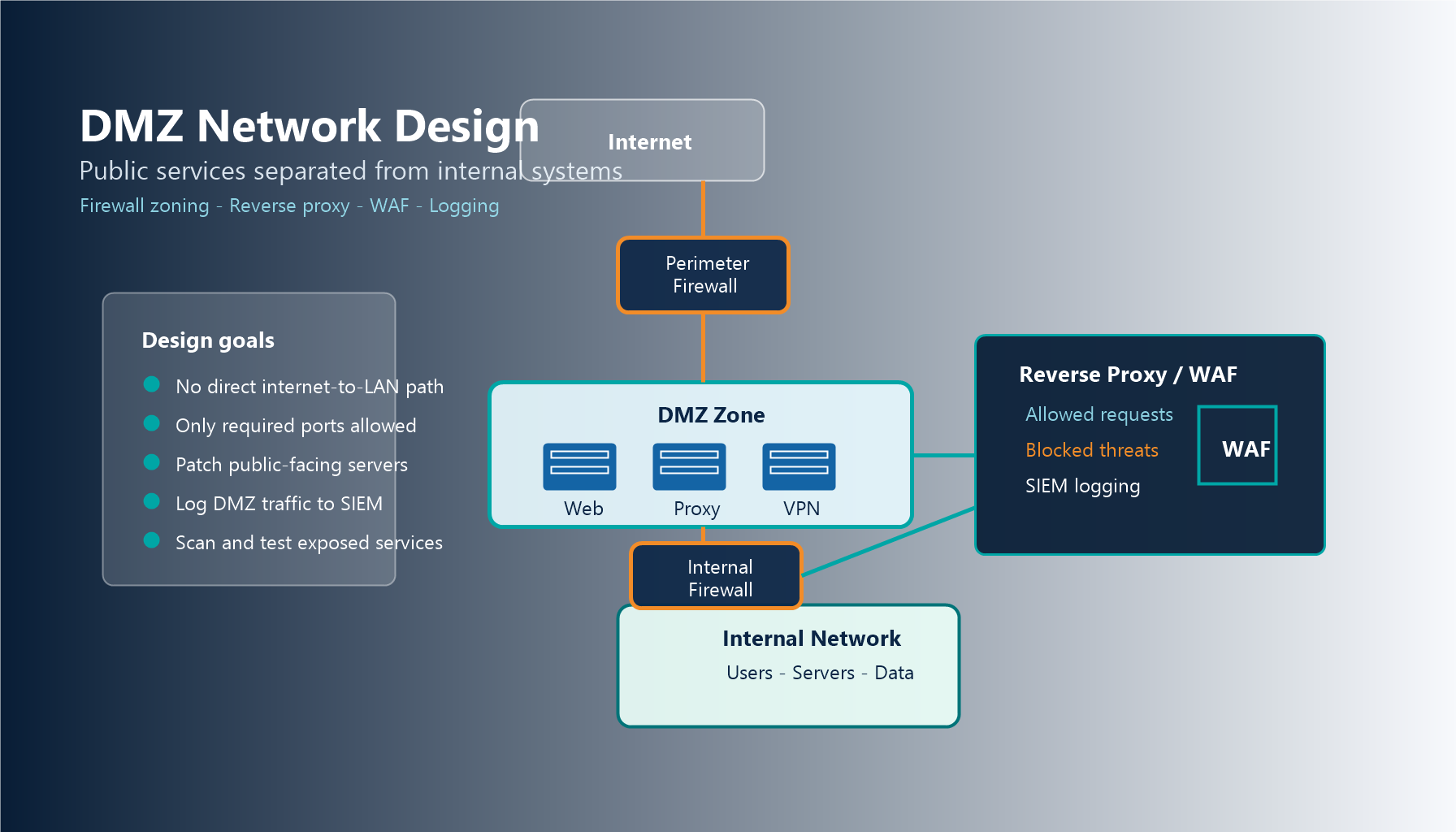
A DMZ helps publish public-facing servers and business services while reducing direct exposure of the internal network. Good DMZ network design security uses firewall zones, reverse proxies, WAF controls, logging, vulnerability scanning, and strict segmentation.
What Is a DMZ
In business networks, a DMZ is used for services that must be reachable from the outside, such as web applications, reverse proxies, VPN portals, SFTP servers, mail gateways, or bastion hosts. The goal is to expose only what is necessary while limiting what those public-facing systems can reach inside the business.
A good DMZ is not just a subnet. It is a security pattern built from firewall zones, NAT rules, routing, server hardening, logging, vulnerability management, and tested segmentation.
Public Servers
Web servers and application front ends should be patched, monitored, scanned, and separated from internal databases.
Remote access portals should use MFA, hardened appliances, current firmware, and logging for failed authentication attempts.
Jump servers should restrict administrative access and avoid becoming an internet-to-domain shortcut.
File transfer, mail, and API gateways need tight rules, malware controls, retention, and audit logs.
NAT and Firewall Zones
NAT translates public addresses to private addresses or maps public services to DMZ hosts. NAT alone does not make a server secure; it must be paired with least-privilege firewall policy, logging, and exposure review.
Firewall zones separate internet, DMZ, internal LAN, server, management, guest, VPN, and cloud segments. Rules should be explicit, logged where useful, and reviewed monthly.
Reverse Proxy
Reverse proxies and application gateways can terminate TLS, route requests, centralize certificates, enforce authentication patterns, and publish only approved paths. They are useful for protecting public services, but they still need patching, monitoring, and careful rule review.
Common reverse proxy designs include Nginx, HAProxy, IIS Application Request Routing, cloud application gateways, firewall-based proxies, and managed edge platforms.
Web Application Firewall
WAF policies inspect requests for attack patterns, suspicious payloads, protocol abuse, and known exploit attempts.
A tuned WAF can reduce exposure during emergency patch windows, but it does not replace server patching.
WAF events should be reviewed, tuned, and correlated with firewall, server, authentication, and SIEM logs.
Highlighted Guidance
DMZ security depends on layered controls. The most important design principle is simple: a compromise of a public-facing server should not automatically become a compromise of the internal network.
Authoritative references: CISA network infrastructure security guidance, NIST Cybersecurity Framework, NIST Zero Trust Architecture, MITRE ATT&CK T1190 public-facing application, NVD vulnerability database, Cloudflare WAF documentation, Microsoft IIS security documentation, Palo Alto security zones documentation, and SonicWall technical documentation.
Vulnerabilities and Misconfigurations
Business Impact
Maintenance Checklist
Related Services and Security Review
Authoritative Links

Ali Hassani, CISO
Ali Hassani, CISO, has 25+ years of experience in IT infrastructure, cybersecurity, network security, Microsoft environments, firewall design, business IT management, and compliance-focused operations. DMZ decisions affect public-facing services, VPN portals, authentication, server patching, logging, vulnerability management, incident response, and internal network protection.
Ali helps businesses connect DMZ design, firewall zoning, reverse proxy publishing, WAF strategy, vulnerability scanning, and network documentation into a practical operating model for Southern California businesses.
CISSP, CCISO, CCNP, CCNA, MCSE, MCSA Security, MCITP, MCP, MCTS.



FAQ
A DMZ is a segmented network zone used to host public-facing services while reducing direct exposure of the internal business network.
Common DMZ systems include web servers, reverse proxies, WAF gateways, VPN portals, SFTP servers, bastion hosts, and application gateways that must be reachable from outside.
No. NAT translates addresses, but a DMZ is a security design with firewall zones, least-privilege rules, monitoring, and segmentation.
A reverse proxy or WAF can inspect traffic, terminate TLS, block common attacks, centralize publishing, and reduce direct exposure of backend servers.
No. This guide is for initial guidance only and does not replace a professional cybersecurity audit, compliance assessment, penetration test, or legal/compliance review.
Need help reviewing public-facing servers, firewall zones, NAT, reverse proxies, WAF controls, VPN portals, bastion hosts, logging, vulnerability scanning, or DMZ maintenance? IT Perfection can help.
Created by Ali Hassani, CISO - 25+ years of IT, cybersecurity, compliance, and infrastructure experience.